Feb. 04, 2026
Weld integrity inspection
Weld Integrity Inspection in Sheet Metal Fabrication
In precision sheet metal fabrication, welding is often the final stage that secures complex assemblies into rigid, functional structures. However, welding also introduces localized heat, internal stresses, dimensional instability, and potential defects that can compromise structural performance if not properly controlled.
Weld integrity inspection plays a critical role in ensuring that each weld meets both structural and cosmetic requirements, maintaining long-term reliability across industries such as medical devices, semiconductor equipment, photonics assemblies, automation systems, and aerospace structures.
At Rollyu Precision, weld inspection is fully integrated into our manufacturing process, delivering consistent weld quality for highly regulated, mission-critical applications.
Why Weld Integrity Inspection is Essential
Ensures structural strength of the assembly
Detects weld defects that can lead to failure under load
Controls post-weld distortion and dimensional stability
Verifies cosmetic appearance for customer-facing parts
Complies with ISO 9001, ISO 13485, and industry-specific welding standards
Minimizes costly rework and scrap
Common Welding Processes in Sheet Metal Fabrication
Welding Method | Typical Application |
TIG Welding | Precision frames, medical enclosures, thin-wall assemblies |
MIG Welding | Automation frames, larger structural panels |
Spot Welding | Electrical enclosures, thin sheet joining, mass production panels |
Stud Welding | Fastener mounting points, structural bases |
Laser Welding (optional) | High-precision seams for specialized thin parts |
Common Weld Defects That Require Inspection
Defect Type | Potential Failure Mode |
Lack of Fusion | Incomplete bonding → weak joint |
Porosity | Trapped gas pockets → crack initiation |
Cracks | Fracture propagation under load |
Undercut | Loss of cross-sectional strength |
Burn-Through | Excessive heat → holes and voids |
Misalignment | Poor joint fit → dimensional shift |
Warpage | Post-weld deformation → fit-up problems |
Weld Inspection Techniques at Rollyu Precision
1️ Visual Weld Inspection (First Line Defense)
Uniform bead width and height
Smooth, consistent weld appearance
No visible porosity, cracking, or undercut
Cosmetic standards for medical, photonics, semiconductor assemblies
2️ Dimensional & Distortion Inspection
Post-weld flatness verification using CMM and surface plates
Warpage and shrinkage control measurements
Hole position verification after welding
3️ Non-Destructive Testing (NDT)
NDT Method | Application |
Dye Penetrant Testing (PT) | Detects surface cracks and open defects |
Ultrasonic Testing (UT) | Identifies internal weld flaws (for thicker or structural parts) |
Magnetic Particle Inspection (MPI) | Shallow subsurface defect detection |
X-Ray (Radiographic Inspection) | High-integrity weld validation (primarily aerospace use) |
4️ Mechanical Testing (Sample-Based)
Weld pull testing (tensile strength validation)
Bend testing (ductility assessment)
Fatigue cycling (load endurance evaluation)
Heat-Affected Zone (HAZ) Monitoring
Monitors grain structure changes caused by welding heat
Controls embrittlement risk near the weld seam
Manages HAZ width to prevent downstream warpage
Critical for thin materials and cosmetic sheet metal assemblies
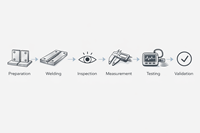
Weld Integrity Inspection in Rollyu Precision Workflow
Stage | Weld Control Focus |
Joint Preparation | Edge fit-up, gap control, pre-cleaning |
Welding Process | Controlled parameters: amperage, voltage, feed rate, shielding gas |
In-Process Visual Checks | Continuous monitoring during welding |
Post-Weld Dimensional Checks | Flatness, hole locations, weld alignment |
Final NDT Testing (as required) | PT, UT, or MPI based on application |
Industries Requiring Strict Weld Integrity
Industry | Weld Integrity Focus |
Medical Devices | Cosmetic finish, biocompatibility, no surface defects |
Semiconductor Equipment | Flatness, vacuum sealing surfaces, distortion control |
Photonics Assemblies | Weld alignment for optical mounting structures |
Aerospace Structures | NDT compliance, fatigue strength, HAZ control |
Automation Systems | Load-bearing frame strength, fastener attachment integrity |
Weld Integrity = Dimensional Stability + Structural Safety
At Rollyu Precision, weld integrity inspection is not limited to visual appearance. We fully control weld quality across:
Joint preparation
Welding process control
Post-weld dimensional verification
Non-destructive testing
Cosmetic appearance for customer-facing parts
By combining multiple inspection layers, we deliver weld assemblies that meet both dimensional and structural expectations — even for industries where zero-defect quality is the standard.
Need reliable weld quality for regulated sheet metal assemblies?
Contact our engineering team to discuss weld inspection requirements, distortion control strategies, and ISO-compliant fabrication support.
Previous: Surface finish standards