Jan. 16, 2026
Tapping and Threading in Sheet Metal Fabrication
In sheet metal fabrication, creating internal threads allows for secure assembly of enclosures, brackets, panels, and structural frames. Depending on material type, thickness, and application, two primary methods are used:
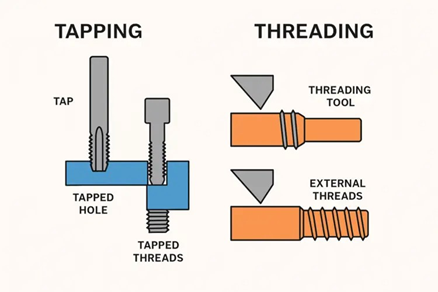
1️ Cut Tapping (Conventional Tapping)
A cutting tap is used to remove material and create internal threads, suitable for most metals.
Suitable for most metals, including aluminum, carbon steel, stainless steel, titanium, and copper alloys.
Delivers precise threads for thin and thick materials alike.
Commonly used for precision enclosures, mounting plates, and robotic frames where assembly strength and repeatability are critical.
2️ Thread Forming (Roll Tapping)
Cold-forms threads without removing material; improves strength in ductile materials like aluminum, brass, and soft steels.Cold-forms the threads by displacing material without cutting.
Ideal for ductile materials like aluminum alloys, soft steels, brass, and copper.
Produces stronger threads due to work-hardening and uninterrupted grain structure.
Reduces the risk of chip contamination, making it well-suited for medical, semiconductor, and cleanroom environments where loose chips are unacceptable.
Excellent for thin-wall sheet metal parts where thread strength must be maximized in limited material thickness.
Suitable Materials for Tapping & Threading
Material | Cut Tapping | Form Tapping | Thread Milling |
Aluminum Alloys | ✅ Excellent | ✅ Excellent | ✅ Excellent |
Stainless Steels | ✅ Excellent | ⚠ Limited (only ductile grades) | ✅ Excellent |
Carbon Steels | ✅ Excellent | ✅ Excellent | ✅ Excellent |
Titanium Alloys | ✅ Good (special taps) | ❌ Not Recommended | ✅ Preferred |
Copper Alloys | ✅ Excellent | ✅ Excellent | ✅ Excellent |
Plastics (Delrin, PEEK, Ultem) | ✅ Excellent | ✅ Excellent | ✅ Excellent |
Threading Standards & Capabilities
Metric Threads (M1.0 – M50)
Unified Threads (UNC, UNF, UNEF)
NPT, BSP, and custom pipe threads
Helicoil (thread insert) preparation and installation
Thread tolerances per ISO, ANSI, ASME, and DIN standards
Machine screw sizes down to #0-80
Quality Control for Threads
Go/No-Go thread plug gauges
Thread ring gauges for external threads
Visual inspection under magnification
Class 2B / 3B / 2A / 3A tolerances for critical threads
Material-specific process controls to avoid galling or thread tearing
Why Tapping & Threading Matter
Precision threads are essential for:
Surgical device assemblies
Semiconductor fixture components
Automation brackets and adjustment mechanisms
Aerospace sensor mounts
Medical robotics housings
Improper thread quality can lead to fastener failure, torque inconsistencies, misalignment, or long-term fatigue issues — especially in industries where every component must meet strict reliability, cleanliness, and assembly repeatability requirements.
Rollyu Precision Advantages
Multi-process CNC threading integration (turning, milling, tapping)
In-house tool management for micro-threads and special pitches
Full documentation & traceability under ISO 9001 & ISO 13485
Specialized tapping for medical-grade aluminum, stainless, titanium
High repeatability for both prototype and production runs
Thread quality directly affects assembly strength, torque consistency, and long-term reliability—especially in thin-wall sheet metal parts.
If you have questions about tapping method selection, thread strength, or material suitability for your application, our engineering team is ready to support you.