Jan. 19, 2026
Surface Finishing in Sheet Metal Fabrication
In high-precision sheet metal fabrication, surface finishing is far more than just a cosmetic upgrade — it plays a vital role in ensuring the performance, longevity, and compliance of the final product. The right finishing process transforms raw fabricated parts into fully functional components, ready for integration into medical devices, semiconductor equipment, industrial automation, and other demanding applications.
At Rollyu Precision, surface finishing is seamlessly integrated into every stage of our tightly controlled manufacturing workflow. This approach guarantees that each part we deliver not only meets strict dimensional and cosmetic standards but also complies with the specific industry regulations our customers operate under.
Surface finishing in sheet metal fabrication involves modifying the surface of metal components to achieve precise functional and visual characteristics. Depending on the application, these processes may either add a protective or functional layer to the surface or refine it by removing imperfections, burrs, or contaminants. As one of the final stages in the production cycle, finishing ensures that parts are fully prepared for downstream processes such as assembly, sterilization, coating, or direct end-use.
Whether it's anodizing for corrosion resistance, electropolishing for cleanroom compatibility, powder coating for color consistency, or fluorocarbon spraying for extreme weather durability, Rollyu Precision delivers surface finishes that meet the exacting standards of industries where precision is non-negotiable.
Why Surface Finishing Matters
Benefit | Description |
Corrosion Resistance | Protects metal surfaces from oxidation, wear, and environmental degradation. |
Aesthetic Quality | Improves surface appearance for consumer products, medical housings, and visible panels. |
Functional Performance | Enhances properties like friction, wear resistance, or conductivity. |
Coating & Adhesion Prep | Provides a uniform surface for anodizing, powder coating, or plating. |
Sterilization Readiness | Smooths surfaces for medical devices that require cleaning and sterilization. |
Regulatory Compliance | Supports ISO 9001, ISO 13485, and industry-specific certifications. |
Common Surface Finishing Processes in Sheet Metal Fabrication
1️ Deburring & Edge Treatment (Pre-Finish Step)
Remove burrs, sharp edges, and micro-defects.
Essential for safety, assembly fit, and proper coating adhesion.
2️ Anodizing
Electrochemical oxide layer primarily for aluminum.
Increases corrosion resistance, hardness, and appearance.
Common Types:
Type II: Decorative, dyeable anodizing
Type III (Hard Anodizing): High wear resistance
Industries: Medical devices, electronics, aerospace, automation panels.
3️ Powder Coating
Dry powder applied electrostatically, then cured.
Excellent chemical, corrosion, and impact resistance.
Wide range of colors, textures, and gloss levels.
Common for enclosures, control panels, automation frames.
4️ Electropolishing
Electrochemical removal of surface material.
Produces ultra-smooth, clean surfaces.
Ideal for stainless steel medical devices and semiconductor components.
5️ Plating (Nickel, Chrome, Zinc, Gold)
Thin metallic layer added for conductivity, wear resistance, or appearance.
Can improve solderability and corrosion protection.
6️ Passivation
Chemical treatment to remove free iron from stainless steel surfaces.
Enhances corrosion resistance, important for medical and food-grade components.
7️ Bead Blasting / Media Blasting
Abrasive media cleans, smooths, or textures surfaces.
Prepares parts for downstream coatings.
Creates uniform matte or satin finishes.
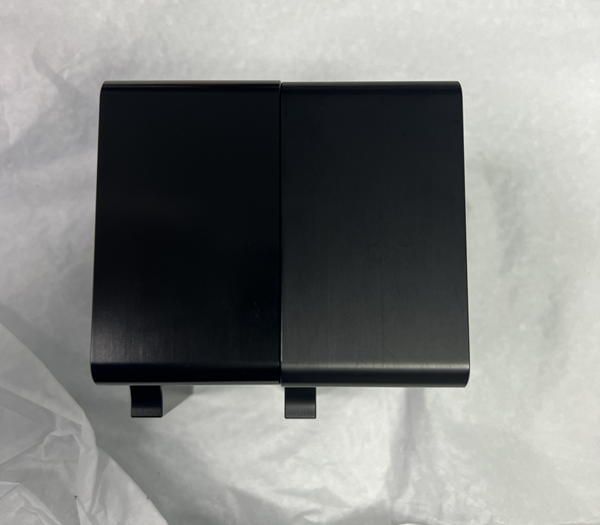
8️ Brushing / Grinding
Mechanical surface preparation to create directional grain or aesthetic patterns.
Common in architectural and visible medical device parts.
Surface Finish Parameters (Ra Values)
Process | Typical Roughness (Ra, µm) |
As-Fabricated | 3.2 – 6.3 µm |
Deburred & Polished | 1.6 – 3.2 µm |
Bead Blasted | 1.2 – 2.5 µm |
Electropolished | 0.2 – 0.8 µm |
Fine Grinding / Brushing | 0.4 – 1.6 µm |
Note: Many medical, semiconductor, and photonics parts require Ra < 0.8 µm for optimal performance.
Industry-Specific Surface Finishing Needs
Industry | Special Surface Requirements |
Medical Devices (ISO 13485) | Sterilizable, corrosion resistant, smooth edges, electropolished |
Semiconductor Equipment | Particle-free, ultra-smooth, electropolished or anodized |
Photonics & Optics | Non-reflective, scratch-free, controlled Ra finish |
Automation & Robotics | Powder-coated durability, scratch resistance |
Aerospace | Lightweight anodized parts, hard anodizing, corrosion-resistant finishes |
✅ Rollyu Precision Surface Finishing Capabilities
ISO 9001 / ISO 13485 certified finishing processes
In-house deburring, brushing, polishing, bead blasting
Partner network for anodizing, plating, electropolishing, passivation
Full traceability and process documentation
Medical-grade and cleanroom-ready finishes
The Complete Surface Finishing Workflow at Rollyu Precision
1️ Fabrication complete
2️ Edge treatment & deburring
3️ Pre-finish surface prep (grinding, brushing)
4️ Primary finishing (anodizing, powder coating, plating, etc.)
5️ Post-finish inspection & documentation
6️ Packaged for shipment or cleanroom assembly
Summary
In high-precision industries, surface finishing is far more than appearance — it directly determines part performance, safety, and long-term reliability. At Rollyu Precision, we engineer surface finishing as part of the full manufacturing solution, ensuring that every part delivered is fully compliant, fully functional, and fully finished.
Surface finish selection directly impacts corrosion resistance, cleanliness, durability, and regulatory compliance—especially in high-precision and regulated applications.
If you need guidance on surface finish selection, Ra requirements, or finishing compatibility with your sheet metal design, our engineering team is ready to support you.