Jan. 30, 2026
Fastener Options: PEMs, Rivet Nuts, and Welding Studs in Sheet Metal Fabrication
In precision sheet metal fabrication, integrating fasteners directly into the sheet metal is critical for achieving reliable assembly, structural strength, and efficient downstream integration. Selecting the right fastener system depends on several key factors, including:
Sheet metal thickness
Load-bearing and torque requirements
Assembly access (single-side or double-side)
Long-term corrosion protection
Required production volume and cost targets
At Rollyu Precision, we collaborate with customers to evaluate fastener types that meet both functional performance and manufacturability requirements — especially across high-precision industries such as medical devices, photonics equipment, semiconductor tools, automation systems, and aerospace assemblies.
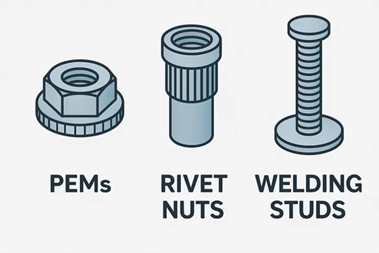
In most sheet metal applications, three primary fastener types dominate:
PEMs (Self-Clinching Fasteners): Provide strong, permanent threads in thin sheet metal with high load retention and flush finishes.
Rivet Nuts (Blind Threaded Inserts): Offer versatile thread reinforcement across a wide range of material thicknesses, with blind-side installation capability for difficult-to-access assemblies.
Welding Studs: Deliver robust, permanent attachment for high-load structural applications where maximum strength and direct weld bonding are required.
Each solution carries distinct advantages depending on design specifications, production volumes, and long-term durability needs.
Why Embedded Fasteners Are Essential in Sheet Metal
✅ Create strong, reliable threaded connections in thin materials
✅ Simplify high-speed assembly and production
✅ Reduce part count and eliminate secondary machining
✅ Support blind-side assembly where access is limited
✅ Improve overall product appearance and safety
✅ Enable field serviceability for long-term maintenance
The 3 Core Fastener Options in Sheet Metal Fabrication
1️⃣ PEMs — Self-Clinching Fasteners
How PEMs Work:
PEMs are press-fit into pre-punched holes using controlled insertion force. As the fastener is pressed into the sheet metal, the surrounding material flows into an undercut groove in the PEM, permanently locking it in place.
Why Use PEMs:
Ideal for thin sheet metal (≥0.5mm)
Create permanent, high-strength threads
Flush or near-flush installation for clean appearance
Fully automated insertion possible for high-volume production
Reliable and repeatable installation
Common PEM Applications:
Medical device enclosures and surgical equipment
Semiconductor tool access panels
Photonics alignment frames
Aerospace interior panels and lightweight structures
Robotic automation control housings
PEM Design Considerations:
Parameter | PEM Rule-of-Thumb |
Min Sheet Thickness | ≥ 0.5mm (depending on fastener type) |
Hole Size Tolerance | ±0.05mm (tight tolerance required) |
Installation Access | Both sides needed |
Materials | Steel, stainless, aluminum sheets |
2️⃣ Rivet Nuts — Blind Threaded Inserts
How Rivet Nuts Work:
Rivet nuts are installed into pre-drilled holes from one side of the sheet. A mandrel pulls the rivet nut body, deforming it behind the sheet metal to securely anchor the fastener, even in blind locations.
Why Use Rivet Nuts:
Allow blind-side installation where access is limited
Adaptable to various material thicknesses
Cost-effective for small-to-medium volume production
Suitable for field repairs or retrofit installations
Require minimal insertion equipment
Common Rivet Nut Applications:
Industrial automation control boxes
Robotic system frames
Telecommunications cabinets
Medical device carts and stands
Field-serviceable panels and access doors
Rivet Nut Design Considerations:
Parameter | Rivet Nut Rule-of-Thumb |
Min Sheet Thickness | ≥ 0.5mm |
Hole Size Tolerance | ±0.10mm |
Installation Access | Single-side (blind access) |
Materials | Steel, stainless, aluminum |
3️⃣ Welding Studs — Projection Weld Studs
How Weld Studs Work:
Weld studs are permanently fused to the sheet metal using resistance welding or capacitor discharge welding. The stud becomes an integral part of the metal structure.
Why Use Weld Studs:
Provide superior tensile and shear strength
Permanent structural attachment
Ideal for load-bearing components
Allow fast one-side installation
Zero fastener spin-out risk
Common Weld Stud Applications:
Aerospace structural panels
Semiconductor tool frames
Heavy-duty automation bases
Robotic machine frames
Transport systems and enclosures
Weld Stud Design Considerations:
Parameter | Weld Stud Rule-of-Thumb |
Min Sheet Thickness | ≥ 1.0mm (for proper weld strength) |
Surface Prep | Clean surface required |
Installation Access | One side only |
Materials | Steel, stainless, limited aluminum |
Quick Selection Summary
Design Requirement | Recommended Fastener |
Thin sheet (≤1mm), high strength | PEM (Self-Clinching Fastener) |
Blind-side assembly | Rivet Nut |
Heavy load, structural strength | Weld Stud |
Cosmetic surface priority | PEM or Countersunk Rivet Nut |
Field repair or serviceability | Rivet Nut |
High-volume automation | PEM with automated press insertion |
Previous: Quality Control & Inspection
Next: Countersinks