Jun. 16, 2026
As we all know, the micropores formed in an anodized film have strong adsorption capability. By using this characteristic, aluminum alloys and other metals can be dyed into various attractive and vivid colors.
However, during actual coloring production, the final color is often not exactly the desired color. Where does the problem come from? This article provides a brief analysis from three key stages of the anodizing process.
The anodized film consists of a large number of hexagonal cells arranged vertically to the metal surface. Each cell has a pore in the center, and these pores have strong adsorption capability.
When anodized aluminum parts are immersed in a dye solution, dye molecules diffuse into the pores of the oxide film and form covalent bonds and ionic bonds with the anodized layer. These bonds are reversible under certain conditions, which means desorption may occur.
Therefore, after dyeing, sealing must be carried out to lock the dye inside the pores while improving the corrosion resistance and wear resistance of the anodized film.
In the entire anodizing and dyeing process, poor dyeing caused by anodizing process issues is very common.
Uniform oxide film thickness and uniform pore distribution are the foundation for achieving consistent color. To obtain a stable and uniform oxide film, sufficient bath circulation, cooling capacity, good electrical conductivity, and stable anodizing parameters are essential.
Key process parameters include:
Recommended range:
180–200 g/L
A slightly higher sulfuric acid concentration can accelerate the dissolution reaction of the oxide film, promote pore expansion, and make dyeing easier.
Recommended range:
5–15 g/L
If the aluminum ion concentration is below 5 g/L, the adsorption capacity of the oxide film decreases, which affects dyeing speed.
If the aluminum ion concentration exceeds 15 g/L, the uniformity of the oxide film may be affected, resulting in irregular film formation.
Recommended temperature:
Around 20°C
The temperature of the anodizing bath has a significant influence on dyeing. If the temperature is too low, the pores of the oxide film become too dense, slowing down the dyeing speed. If the temperature is too high, the oxide film becomes loose and may powder, making dyeing difficult to control.
The temperature variation of the anodizing bath should preferably be controlled within ±2°C.
Recommended range:
120–180 A/m²
If the current density is too high, the electrolysis time must be shortened to achieve the same film thickness. This reduces the dissolution of the oxide film in the solution, makes the pores denser, and extends the dyeing time. It may also cause the film to become powdery.
For dyeing applications, the anodized film thickness should generally be above 10 μm.
If the film is too thin, uneven dyeing is likely to occur. For dark colors such as black, insufficient film thickness limits dye absorption and makes it difficult to achieve the required color depth.
In summary, anodizing is the pre-treatment foundation for dyeing. Many anodizing-related problems are difficult or impossible to detect before dyeing. Once the part is dyed, defects such as uneven color become obvious. At this stage, production teams often blame the dyeing process while overlooking the root causes in the anodizing process.
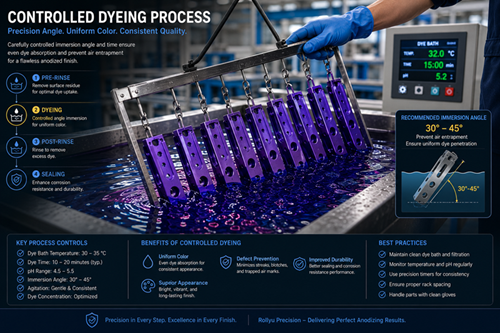
After anodizing, sulfuric acid solution remains inside the pores of the oxide film. Therefore, aluminum parts must be thoroughly rinsed before dyeing.
This prevents impurity ions, especially phosphate ions and fluoride ions, from being carried into the dyeing bath. It is necessary to set up a pure water rinsing process before dyeing and monitor the water quality.
Most dyes used for anodized aluminum are organic dyes, which are prone to mold growth.
To prevent contamination, the dyeing tank may be disinfected before solution preparation using agents such as bleaching powder or phenol-based disinfectants. Adding anti-mold agents during bath preparation can also extend the service life of the dye solution.
After the dyeing bath is prepared, it should be stored for several hours before use. To stabilize the pH value, an acetic acid-sodium acetate buffer solution can be added.
During dyeing, the dyeing rate increases as temperature rises. Therefore, the time required to reach a specific color depth becomes shorter at higher temperatures.
However, higher temperature also accelerates simultaneous sealing. If the temperature is too high, the pores may close before enough dye molecules are absorbed, preventing the color from reaching the required depth.
At relatively lower temperatures, deeper colors can be achieved, but longer dyeing time is required. Therefore, the dyeing temperature should be adjusted according to different color requirements to avoid excessively long or excessively short dyeing times.
According to adsorption principles, under certain working conditions, the amount of dye adsorbed by the anodized film increases as the dye concentration increases.
However, this rule only applies when the oxide film still has adsorption capacity. Dye concentration should be adjusted according to the required color depth.
When preparing the dye bath, it is better to start with a relatively low concentration. As production continues and dye is consumed, the dye should be replenished in small amounts multiple times.
When measuring dye concentration, the influence of impurity ions must be considered. The actual effective dye concentration may differ significantly from the measured value. Therefore, the actual coloring strength of the dye bath should be regularly tested through comparison samples.
To maintain stable dyeing performance, part of the dye bath should be replaced after a certain production period.
When other conditions remain unchanged, the color gradually deepens as dyeing time increases.
Generally, once the anodizing conditions, dye concentration, and temperature are fixed, the required color depth is mainly achieved by adjusting dyeing time.
If the required color is achieved too quickly, there are two disadvantages:
First, color uniformity is difficult to control.
Second, the weather resistance of the color may be insufficient.
If the dyeing time is too long, or the required color depth still cannot be achieved no matter how long the part is dyed, the oxide film may be too thin or the dye concentration may be too low.
The dyeing bath pH is generally required to be 5–6.
Stable pH is very important for dyeing, especially when mixed dyes are used. Different pH values may produce different color tones.
Adding a buffer solution during bath preparation is a feasible way to improve pH stability. At the same time, rinsing before dyeing must be strengthened to prevent acidic substances from being carried into the dye bath.
After dyeing, aluminum parts must be rinsed to remove floating dye from the surface.
The water quality of the rinsing tank is very important. Because the bonding between dye molecules and the oxide film is reversible, excessive impurity ions in the water may cause dye molecules to detach from the oxide film and enter the water.
This leads to fading. Such fading is often uneven and eventually causes color difference on the same part.
Sealing is an essential step after anodizing.
After anodizing and dyeing, sealing is necessary to maintain the original color of the dyed film.
Common sealing methods include:
· Steam sealing
· Hot water sealing
· Medium-temperature sealing
· Cold sealing for certain dyes
After sealing, the color may become slightly lighter than before sealing due to minor fading.
In the anodizing process, color difference can be controlled by adjusting the above factors.
However, the key questions are:
How much should be adjusted?
What is the correct adjustment direction?
Is there a method to obtain accurate numerical data for reference?
Today, more anodizing companies use colorimeters to monitor process quality. A colorimeter can detect color deviation data and help adjust each process step more accurately.
Each adjustment can be recorded numerically by the instrument, showing the corresponding color change and helping determine the proper adjustment range. This replaces rough visual judgment by the human eye.
A colorimeter can also be used for incoming material inspection to control color variation from the source.
After aluminum alloy anodizing, an oxide film is formed on the surface. This film provides oxidation resistance, rust prevention, corrosion resistance, and wear resistance. The anodized film is also stable in natural environments and protects the aluminum surface.
Because the outer layer of the anodized film is porous, it can easily absorb dyes and colored substances, improving the decorative appearance. After hot water sealing, high-temperature steam sealing, or nickel salt sealing, corrosion resistance and wear resistance can be further improved.
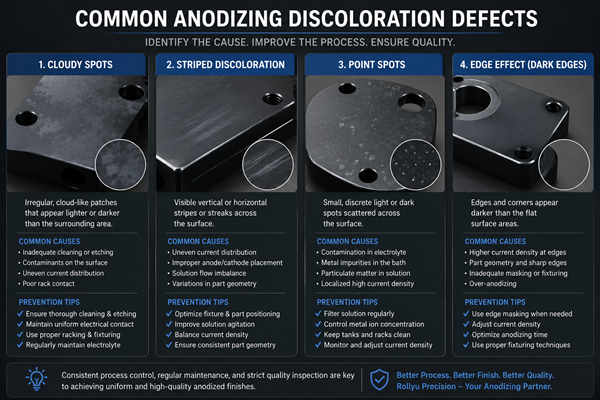
Common coloring defects of aluminum profiles include:
· Light color
· Color difference
· Failure to dye
· White spots
· Exposed white areas
· Uneven dyeing
· Dye bleeding or color loss
To ensure consistent color from batch to batch, technicians must study and prevent these issues during electrolytic coloring and anodized surface treatment.
Possible cause:
Uneven temperature or concentration in the anodizing bath.
Solution:
Use compressed air agitation or proper bath circulation to improve uniformity.
Solution:
Introduce agitation and increase the frequency of stirring.
The bottom of the workpiece enters the dye bath first and leaves last, making the bottom area darker.
Solution:
Dilute the dye and properly extend the dyeing time.
Possible cause:
Loose fixture or poor rack contact.
Solution:
Ensure the parts are securely mounted and have good electrical contact.
Solution:
Add dye to increase concentration.
Solution:
Heat the dye bath, generally keeping it below 60°C.
If dye is not fully dissolved or undissolved dye particles float in the bath, color difference may occur.
Solution:
Improve dye dissolution and filtration.
The above points mainly address color differences on a single part or between different surfaces of the same part.
For batch-to-batch color variation, the key is to standardize and digitize process parameters.
For example, dye concentration, dye temperature, and dyeing time should be controlled according to the same standards used during trial production or the previous approved batch.
This can significantly reduce or even prevent batch color differences.
Aluminum anodized coloring can provide excellent decorative effects. According to the coloring method, it can be divided into:
· Self-coloring
· Adsorption dyeing
· Electrolytic coloring
Fading problems mostly occur in adsorption dyeing. Since the dye is adsorbed on the pore surface of the anodized film, fading can occur if sealing is not properly completed.
Among various sealing methods, hot water sealing is simple and low-cost but has limited effectiveness. Steam sealing is more expensive but provides the most obvious sealing effect.
After excluding the influence of casting and extrusion, most color differences in anodized profiles come from the anodizing production process itself.
During anodizing and coloring, bath composition, current and voltage settings, equipment, and operator control are all complex influencing factors.
Assuming an ideal and consistent oxide film cell structure, under specific medium conditions, the color depth depends on the amount of metal particles deposited in the oxide film pores. Therefore, the relationship among bath composition, coloring time, current, and voltage must be carefully controlled.
In real production, the oxide film structure is not perfectly uniform. Film thickness variation, uneven porous layer depth, and differences in bath composition can all affect the deposition of Ni or Sn particles.
Therefore, color difference in electrolytic coloring is directly related to:
· Coloring mechanism
· Oxide film thickness
· Electrolytic coloring speed
Typical defects include:
· Inconsistent color depth
· Different color at both ends
· Yin-yang surface color difference
· Failure to color
· White ends
· Color loss
When preparing the coloring bath, deionized water must be used.
If using a single tin salt bath, add H₂SO₄ and stabilizer first and fully dissolve them before adding SnSO₄. This helps prevent Sn²⁺ oxidation and hydrolysis.
If using a double-salt bath, SnSO₄ can be added into the nickel salt solution.
After preparation and during normal production, the bath composition should be sampled and analyzed regularly. Additives should be added according to the analysis results to keep the bath stable. Additions should be made in small quantities multiple times.
The concentration of each component directly affects color difference.
Generally:
· Higher main salt concentration increases coloring speed and deepens the color.
· Sulfuric acid helps maintain coloring stability.
· Excessive sulfuric acid may cause hydroxide deposits on the tank or components.
· Too little sulfuric acid may cause excessive H⁺ competition, reducing coloring speed or preventing coloring.
· H₃BO₃ acts as a buffer inside the pores.
· In tin salt solutions, if boric acid is not added, tin may fail to deposit, causing color difference and poor color dispersion.
· Accelerators in nickel salt solutions act as catalysts, helping Ni²⁺ deposit smoothly at around pH 1.
· Stabilizers are composed of complexing agents, reducing agents, antioxidants, and electrode oxidation inhibitors. They prevent stannous ion oxidation and hydrolysis and maintain coloring stability.
Proper agitation improves color uniformity and repeatability.
Single nickel salt solutions can usually be agitated with compressed air. However, single tin salt or double-salt solutions should not use compressed air agitation. Inert gas agitation or mechanical stirring can be used to prevent oxidation of stannous ions.
Circulation filtration is also an effective way to maintain solution stability.
Voltage has a major influence on coloring speed.
If the voltage is too low, the cathodic peak current is small and is mainly used for barrier layer charging and compensating electrical loss. The Faradaic current for metal deposition is low, resulting in lighter color.
As voltage increases, current increases, coloring speed accelerates, and the color sequence generally changes as follows:
Light coloring → Champagne → Coffee → Bronze → Brown → Black
However, when voltage reaches an excessive level, the color may become lighter again. This is because the voltage exceeds the anodizing voltage range, causing the barrier layer to break down and the colored film to detach.
Before racking, operators should check the conductive rods and polish the contact areas to ensure good conductivity.
During racking:
· Calculate the total surface area of each load.
· Do not exceed the allowable loading range.
· Avoid loose binding.
· Keep profile cross-sections consistent or similar in each rack.
· Maintain equal spacing between parts.
· Ensure a proper tilt angle when entering the coloring bath.
Otherwise, color difference may occur between parts in the same rack.
Coloring time also has a significant effect. Short coloring time causes a light tone. Longer coloring time deepens the color. However, if coloring time is too long, the stability of the oxide film surface must be considered.
Bath temperature also affects color difference.
Generally, when solution temperature increases, metal ion diffusion speed increases, the chance of reduction inside pores rises, and the color becomes deeper.
If the temperature is too low, coloring becomes slower. If the temperature is too high, stannous ions may oxidize and hydrolyze faster, and the oxide pore structure may even be damaged.
The coloring bath temperature is usually controlled at:
18–22°C
Human factors are an important cause of color difference.
When operators lack responsibility or experience, process fluctuations can easily lead to obvious color variation.
Key operators include:
· Racking workers
· Crane operators
· Color matching technicians
Racking workers must master inspection before and after racking, proper tightness, and surface area calculation. These skills should be improved through training and on-site experience.
Crane operators are critical for ensuring reaction time and coloring uniformity.
Before coloring, the crane hook should be separated from the conductive beam and kept still for 0.5–1 minute before power is applied.
The voltage should be preset before coloring. Coloring time should be kept stable with minimum fluctuation.
After coloring, parts should be lifted immediately at an angle to drain the solution quickly and transferred to the rinsing tank without delay.
Parts should not stay in the coloring bath after coloring, especially when using double-salt or single tin salt coloring agents. Improper operation may cause color difference and edge defects.
The lifting time in the air must be strictly controlled. Acid in internal holes must be thoroughly washed out before color matching.
When comparing color, technicians should use standard samples.
The part color should be slightly deeper than the standard sample before sealing. If the color is slightly light, the part can be returned to the coloring bath for additional coloring. If the color is too dark, it may be placed in the coloring bath for fading. However, some colored profiles cannot be faded, depending on the color and bath composition.
Oxide film thickness control must also be strengthened. During anodizing, bath concentration, temperature, current density, and anodizing time significantly affect pore structure arrangement and depth.
The workshop must coordinate and match these parameters to ensure oxide film uniformity and stability.
After anodizing, parts should be colored immediately. If anodized parts are exposed to air for too long, the pores may shrink and may be contaminated by acid mist, dust, or other pollutants, making dyeing difficult.
If the dyeing tank is too small and parts cannot be dyed immediately, the profiles should be temporarily immersed in a separate pure water tank.
Post-coloring rinsing is also very important. Colored profiles should go through two-stage rinsing. Poor water quality can cause color difference and may later lead to poor sealing or poor electrophoretic coating adhesion.
Color difference in aluminum alloy anodizing must be managed from multiple aspects, including raw material consistency, surface preparation, process parameters, and inspection methods.
Small differences in aluminum alloy composition can significantly affect anodized color.
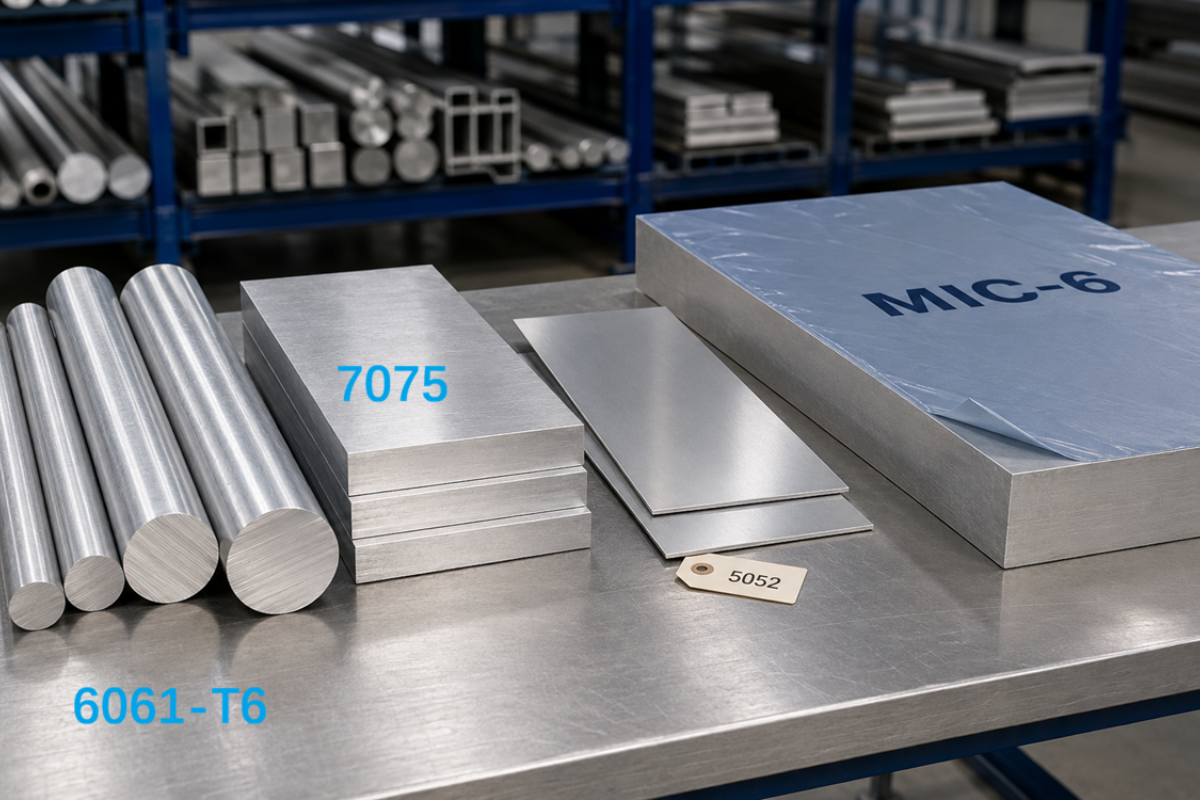
Therefore, aluminum bars or plates should preferably come from the same batch and the same supplier. Avoid mixing materials with different compositions or different heat treatment conditions.
Before machining, ensure that raw material identification is clear. This supports traceability and quality consistency management and reduces the risk of anodizing color difference.
Surface pre-treatment directly affects final color uniformity.
Degreasing, alkaline cleaning, neutralization, and fine rinsing must be complete and consistent to avoid local residue or uneven treatment.
During batch processing, part spacing and rack contact area should be kept consistent.
This prevents local color variation or uneven brightness caused by uneven current distribution.
Current density, bath temperature, processing time, and other variables affect oxide film thickness and dye adsorption capability.
All parts in the same batch should be processed under the same parameter conditions.
Bath composition and concentration should be tested regularly.
The dye bath should remain fresh and temperature-controlled.
Dye aging, precipitation, or contamination may cause uneven color.
A colorimeter can provide objective quantitative evaluation of aluminum surface color.
By using Lab* values and ΔE values, manufacturers can accurately measure color deviation and adjust the process accordingly.
Based on measurement data, an acceptable color tolerance should be defined.
If the ΔE value between the production sample and the approved standard sample falls within the agreed tolerance, the part can be accepted.
Common causes such as excessive dyeing speed, uneven dye concentration, and low dye bath temperature can be improved by:
· Adjusting dye concentration
· Extending dyeing time
· Heating the dye bath
· Improving dye dissolution
· Strengthening agitation
· Improving electrical contact
· Enhancing rinsing quality
Through these methods, color difference in aluminum alloy anodizing can be effectively controlled, ensuring consistent appearance and stable quality.
Color difference in aluminum alloy anodizing is not a single-factor problem. It is caused by the combined effects of raw material consistency, pre-treatment quality, anodizing parameters, dyeing conditions, sealing quality, bath maintenance, and operator control.
The key is to understand the principle behind the defect, build a scientific quality control system, standardize every process parameter, and continuously optimize production conditions.
With proper process control, aluminum alloy anodizing can achieve stable color, consistent appearance, reliable corrosion resistance, and high-quality surface performance.