Jan. 22, 2026
Bead Blasting (Sandblasting / Glass Bead Blasting)
Process Type: Mechanical abrasive blasting
What Is Bead Blasting?
Bead blasting is a mechanical surface treatment that uses high-pressure air to propel small, round media (glass beads, ceramic beads, or stainless steel shots) against the surface of the workpiece.
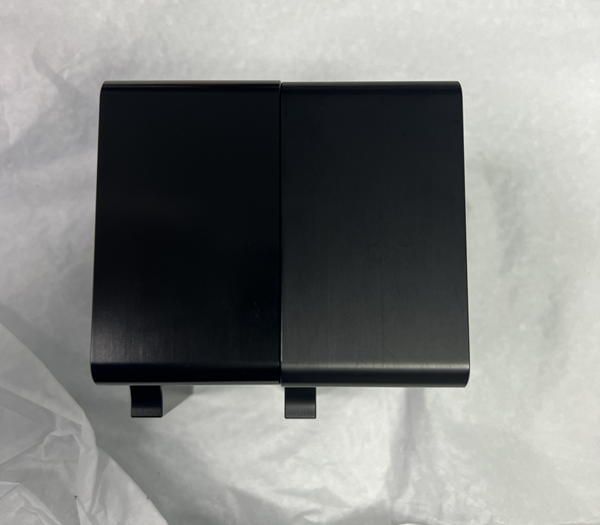
Unlike aggressive sandblasting or shot blasting, bead blasting is a non-destructive, gentle process that refines the surface without removing significant base material. It produces a uniform, matte or satin finish — highly desirable for many industries requiring both aesthetic consistency and functional surface performance.
Why Bead Blasting Is Used in Sheet Metal Fabrication
Surface Preparation Process | Surface Removal | Aggressiveness | Typical Finish |
Bead Blasting | Very Low | Gentle | Satin / Matte |
Sandblasting | Moderate to High | Aggressive | Rough |
Shot Blasting | High | Heavy | Peened Surface |
Grinding/Polishing | Variable | Manual | Shiny/Smooth |
Bead blasting is typically used:
Before anodizing (to improve dye uniformity)
Before powder coating (to enhance adhesion)
For cosmetic matte finishes (non-glare surfaces)
To eliminate micro-burrs or surface imperfections
The Bead Blasting Process at Rollyu Precision
Here’s how bead blasting is integrated into our sheet metal workflow:
1️⃣ CNC Cutting
2️⃣ Bending/Forming
3️⃣ Welding (if applicable)
4️⃣ Deburring & Edge Treatment
5️⃣ Bead Blasting (Surface Preparation)
6️⃣ Post-Blast Inspection
7️⃣ Final Finishing (Anodizing, Powder Coating, etc.)
8️⃣ Final Inspection & Packaging
Our controlled process ensures uniformity across production runs, even on complex geometries, tight corners, and internal cavities.
Advantages of Bead Blasting for Sheet Metal Parts
✅ Uniform Appearance
Removes minor tool marks, discoloration, and inconsistencies, creating a consistent surface for aesthetic and functional purposes.
✅ Improved Adhesion
Increases surface area microscopically, improving powder coating or anodizing adhesion.
✅ Non-Aggressive
Won’t distort thin sheet metal parts or alter critical dimensions — critical for medical devices, enclosures, and precision parts.
✅ Clean & Non-Contaminating
Glass or ceramic media leaves no embedded residue, making it suitable for sensitive industries like medical, semiconductor, and aerospace.
✅ Versatile
Effective on aluminum, stainless steel, titanium, and various alloys.
Industry Applications of Bead Blasting at Rollyu Precision
Medical Devices
Surgical housings, covers, panels, and brackets with uniform matte finishes.
Pre-anodizing surface preparation for color consistency.
Biocompatible and cleanroom-friendly processes.
Semiconductor & Photonics
Optical alignment frames and chambers requiring non-reflective surfaces.
Clean, particulate-free surfaces for vacuum or cleanroom environments.
Robotics & Automation
Machine covers, panels, and safety guards where cosmetic appearance and finish uniformity are important.
Aerospace & Defense
Lightweight aluminum or titanium parts requiring controlled surface roughness for coating and performance.
Industrial Equipment & Electronics
Enclosures, racks, control boxes with uniform matte finishes and improved corrosion resistance.
Design Considerations for Engineers
Material Selection: Aluminum, stainless, and titanium respond best.
Geometry Access: Avoid deep internal recesses that may block media flow.
Masking: Critical surfaces, threads, or sealing faces may require masking.
Surface Finish Specs: Typical Ra surface roughness after bead blasting: 0.8–3.2 µm (32–125 µin).
Post-Blasting Finishes: Ensure compatibility with downstream anodizing or coating processes.
Why Rollyu Precision for Bead Blasting?
✔ ISO 9001 & ISO 13485 certified
✔ Cleanroom-compatible processes
✔ Controlled bead blasting booths with dedicated media types
✔ Full traceability and in-process inspection
✔ Integrated finishing workflow — from raw sheet metal to finished product
At Rollyu Precision, bead blasting is not a standalone process. It is fully integrated into our fabrication and finishing operations to ensure that each part meets both aesthetic and functional specifications — every time.
Typical Materials: Aluminum, stainless steel, titanium
Benefits:
Creates uniform matte or satin finish
Removes machining marks, scratches, or oxidation
Excellent pretreatment for anodizing or coating
Enhances visual texture without significantly altering dimensions
Low-cost, fast process
Bead blasting is often the critical step that determines surface consistency, coating quality, and dimensional stability—especially for thin sheet metal parts.
If you need guidance on bead blasting suitability, Ra requirements, masking strategy, or compatibility with anodizing or powder coating, our engineering team is ready to support you.